News

  • On Suspending Our NFT Offering

    Right before the holidays, I decided to suspend offering NFTs of the Faces of Open Source photographs due to hostility and attacks on Twitter and elsewhere. 

    If the hostility had only been directed at me, I would’ve tolerated it, but sadly, it spilled over to some of the people I photographed. Not wanting this project to be a source of angst for anyone, or a litmus test for being on the “right” side of the NFT argument, I decided that a suspension was best. 

    That said, I want to address many of the misconceptions tweeted about the NFT offering, photography rights, and the Faces of Open Source project in general. I also want to offer a photographer’s perspective on NFTs and why I believe they are important for artists.

    (more…)
  • Putting Faces on the Blockchain: why we are selling NFTs

    UPDATE 12/23/21: We’ve suspended this program for now. Read about why here.

    One of the questions I’m asked most frequently about the Faces of Open Source project is “why haven’t you photographed (insert name here)?”. The answer is most likely that I just haven’t gotten to them yet. This kind of ongoing photo documentation takes A LOT of time to produce, and while I’d like to do more photo shoots each year, it often comes down to funding.

    When I began the project in 2014, my initial idea for funding the project was to produce and sell a coffee table book of the photographs. But over time, I realized that a book would be missing the last 9-12 months of new Faces by the time it landed on coffee tables. Selling a book isn’t a great way to fund an on-going project.

    As I continued thinking about alternative (and creative) ways to fund the project, I was also watching this explosion of NFTs (aka Non-fungible tokens) in the art marketplace. As a photographer used to licensing digital copies my photos (or selling physical versions as fine art prints) I wasn’t sure where photography might fit into the NFT universe. But, once I realized that NFTs are analogous to a “digital print”, I began to wonder if they’d be a fun way to fund Faces of Open Source.

    And so… I’m excited to announce that beginning on April 7th, we’re going to begin selling non-fungible tokens (NFTs) of the Faces of Open Source photographs. 

    NFTs for Photographs? Really?

    I realize that you might be tired of hearing about NFTs. They’ve certainly been in the news a lot. You might’ve read about how one artist is selling NFTs of his digital art for millions. Or how the NBA has used NFTs to create a market for videos of “moments” from basketball games. The whole NFT space looks like a giant money grab right now. That said, NFTs are here to stay because they make any kind of digital file uniquely collectable – even photographs.

    Selling NFTs of photos is very similar to selling limited edition fine art prints (which I’ve been doing for years), except that with NFTs, collectors are buying “one of a kind” digital copies made possible by the magic of the blockchain. When you buy one of our NTFs, this means you will own one of the limited number of copies (of each photograph) we will ever make available. This is currently the only way to collect and own the Faces of Open Source photographs.

    Should I buy a Faces NFT?

    Yes you should! Here are some of the unique things about our NFT sale:

    1. This is the largest collection of photography ever sold exclusively as NFTs.
    2. Each NFT is limited to 755 copies, with only 10 copies of each photo available to start.
    3. This is my first NFT offering as an artist (some people seem to care a lot about this!).
    4. These photographs are particularly historically relevant and will become more so over time.
    5. Part of the proceeds from our NFT sales will go back into the open source community through donations to organizations and foundations featured in the project.

    This last item is really important. It’s not lost on me that there would be no NFTs or blockchain (or this project for that matter) without the work of the open source community.

    Donors Become Owners 

    Another thing that I really like about NFTs is that they have the potential to radically change the fundraising conversation around creative projects. Instead of asking (ok, begging) people to make charitable donations, NFTs can be used to sell ownership of a tangible piece of the project itself. 

    Making a donation versus buying a NFT might seem like semantics, but I think NFTs have the ability to change people’s behavior. Whenever we own something it means we have the potential to build equity. If you’ve ever owned a home, or been granted stock options in a startup venture, then you know powerful a motivator equity is when it comes to making something a success. I want everyone who owns a piece of this project to have a reason to see it grow and flourish into the future. Funding derived from ongoing NFT sales could be the way to make that happen.

    If you’re looking for a way to support the historical documentation of the open source revolution, go buy one of our NFTs. 😀

    UPDATE 12/23/21: We’ve suspended this program for now. Read about why here.

  • Happy 20th Birthday Wikipedia

    Wikipedia turned 20 today. What started as a grand experiment to create a better encyclopedia has turned into essential fabric that now holds together the discourse of modern society.

    Here is a favorite shot of Katherine Maher who is the executive director of the Wikimedia Foundation. She has been leading the organization since taking the reigns in 2016.

    Katherine  Maher
    Katherine Maher — Executive Director, Wikimedia Foundation.

    I hope to add more Wikipedians to the project as there are many more unsung heroes that deserve recognition in that community.

  • Faces Exhibit at OSCON 2019

    Someone once described O’Reilly’s OSCON conference to me as a sort of “homecoming”. I didn’t really understand what they meant until the team at O’Reilly Media invited us to exhibit the Faces of Open Source at this year’s conference.

    For the past twenty years, the open source community comes together at OSCON for a week of open source talks, seminars, and networking. For many attendees, OSCON is a chance to put faces to names that they might only know from interactions online — which meant our exhibit fit right in with the ethos of the conference.

    OSCON attendees stop to view a contributors from the Robot Operating System (ROS) project.
    Attendees stop to view the Faces of Open Source Exhibit at OSCON 2019.

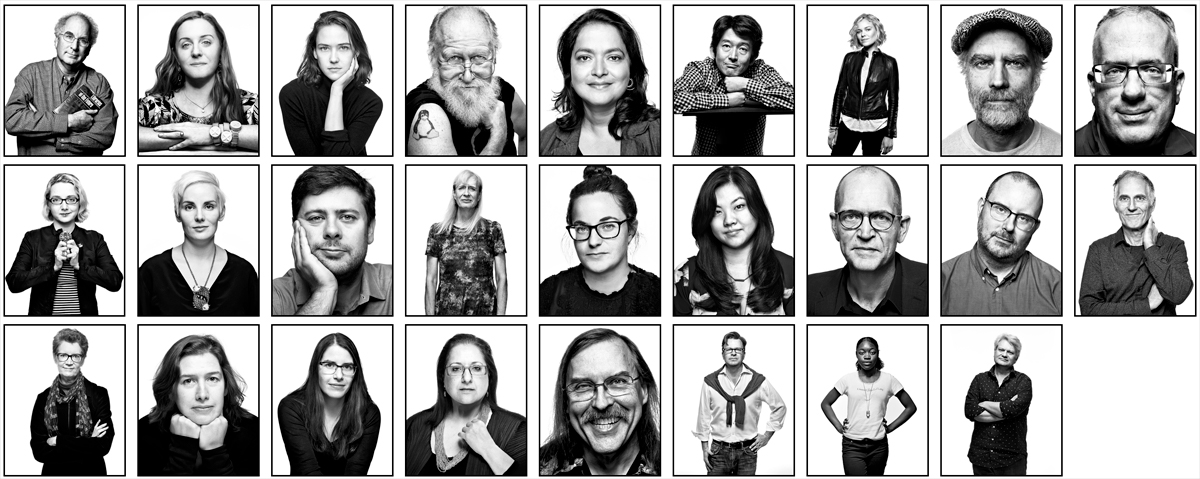
    The exhibit provided a unique way for attendees to see faces from the broader open source community and to learn about their contributions to open source projects and history.

    As the number of Faces in the project has grown, we’ve had to put a lot of thought into how best to exhibit 100+ portraits. For OSCON, we opted to do a digital exhibit using a series of large monitors in portrait orientation. The OSCON team created a wonderful surround for the monitors which rotated through a sequenced loop of the portraits.

    https://twitter.com/zahedab/status/1150624626688442368?s=21

    Another cool feature of the exhibit were the unique QR codes that we added to each photograph. Viewers could scan any Face’s QR code with their mobile phone to pull up detailed caption info about the person from our website.

    I want to thank the team at O’Reilly for making this happen. It personally meant a lot to me to see the OSCON community interact with the exhibit. And yes, it really did feel like coming home.

  • Linus on the Cover of Linux Journal

    Honored to have our photo of Linus Torvalds on the cover of the 25th Anniversary issue of Linux Journal. If you are not already a subscriber to Linux Journal please consider supporting their work!!

    img_8574 by .

  • Happy 20th Anniversary Open Source!

    Can you imagine if twenty years ago a group of mavericks had not developed a plan to accelerate the adoption of free and open software? We’d probably still be logging into AOL or browsing a warped version of the Web with Microsoft’s Internet Explorer. Yikes.


    Today, February 3rd, marks the 20th anniversary of the name “open source”.


    Choosing a name


    Faces of Open Source participant Christine Peterson, who coined the name, recently posted her first-hand account of how the open source label came to be. If you like tech history, Christine’s piece is a must-read.


    How old is open source really?


    In reality, open source is a lot more than 20 years old.


    For example, Linus Torvalds created Linux in 1991 – the very same year that the BSD operating system was first freely distributed. Also, the X Window System and Richard Stallman’s GNU project both began in the 1980’s.


    The roots of open source might even be traced back to the 1970’s when the Unix team at Bell Labs would “snail mail” source code to anyone who asked for it.


    Suffice it to say, open source is standing on the shoulders of giants who were creating and sharing open source software long before 1998. They were just calling it by another name: “free software”.


    However, by the 1990’s, that name was starting to become problematic.


    For one, the word “free” was confusing. Richard Stallman, who started the free software movement, would often clarify that free was short for “free speech” and not “free beer”. This explanation helped, but not enough for businesses to get over their fear of adopting “free” software.


    And so, a group of free software advocates found themselves in a conference room twenty years ago searching for a new label to explain free software.


    The rest, as they say, is history.


    Today, free and open source software permeates our modern way of life, playing a foundational role every time billions of people send email, visit a website or pick up their smartphones.


    Whose shoulders are those?


    If you ask me, the broader open source revolution might be the single biggest tech catalyst of the 21st century! And yet, outside of the technology industry, those responsible for open source remain largely unknown.


    I find this inconceivable and it’s what drives me to document the Faces of Open Source. If you feel the same way, this 20th anniversary of the open source name is a great opportunity to help spread the word.

  • 2017 – It’s a Wrap

    2017faces by .

    2017 was an action-packed year for Faces of Open Source.

    My traveling photo studio made its way to New York, San Francisco, Silicon Valley, Santa Cruz, Palm Springs, and Los Angeles.

    I photographed 26 new faces which brings the total number of participants to 72!

    New Faces added in 2017

    I’m so excited for you to see the new Faces and learn about their contributions to open source. Here’s the full list in the order they were photographed:

    Larry Wall

    Jim Zemlin

    Christine Peterson

    Keila Banks

    Stormy Peters

    Karen Sandler

    Bradley Kuhn

    Sally Khudairi

    Tim O’Reilly

    Doug Cutting

    Mary Ann Horton

    Camille Fournier

    Helen Hou-Sandí

    Limor Fried

    Tom Igoe

    Jessie Frazelle

    Eliot Horowitz

    Katherine Maher

    Zaheda Bhorat

    Brendan Eich

    Junio Hamano

    Jim Kent

    Sara Chipps

    Pia Mancini

    Jon “maddog” Hall

    Brewster Kahle


    I’m looking forward to a little break from travel and then it’s on to 2018 and a whole new set of Faces. Stay tuned!

Search